

.png)
Key takeaways:
- Online tutoring is a research-backed intervention that can improve student performance when delivered by skilled educators.
- The effectiveness of online tutoring boils down to the overall quality, design, engagement, and consistency of the lessons.
- Online tutoring offers flexibility, wider access to specialist tutors, and tools that make learning both fun and accessible.
- For many students, online tutoring leads to outcomes that are comparable to (if not better than) regular face-to-face lessons.
Is online tutoring effective?
Yes. There’s a growing field of research that increasingly suggests online tutoring can have a meaningful impact on students’ learning.
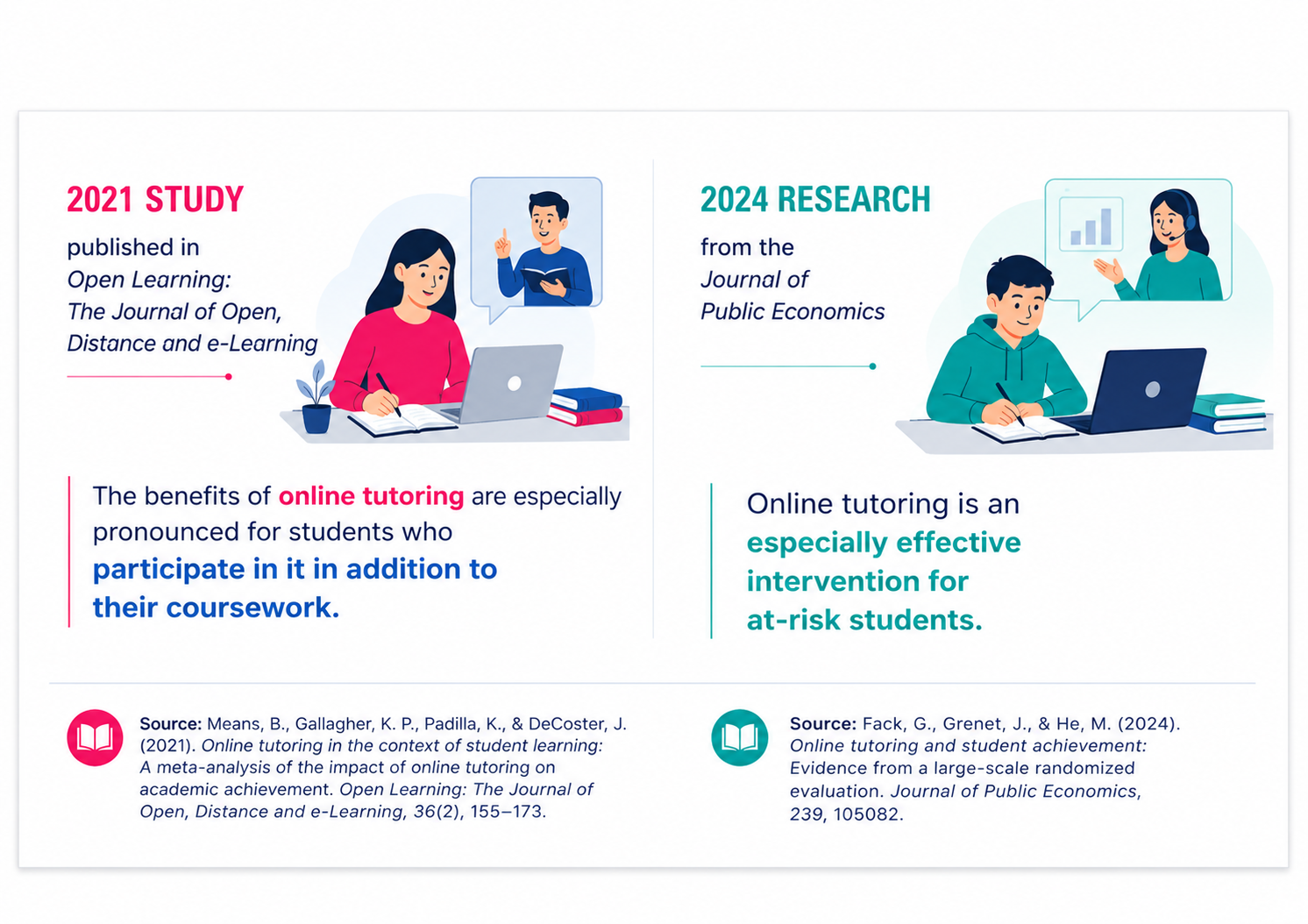
As a 2021 study published in Open Learning: The Journal of Open, Distance and e-Learning found, the benefits of online tutoring are especially pronounced for students who participate in it in addition to their coursework. The authors say that those who actively engaged with online tutoring had significantly higher test scores than those who didn’t participate.
That shouldn’t come as much of a surprise. Technology has also come a long way; today’s virtual classrooms make it possible to achieve exactly what you would in person. Modern online tutoring allows students and tutors to work through interactive activities together in the exact same ways they would in a real classroom — with the added benefit of being able to revisit the lesson recordings afterwards.
In many ways, online tutoring has evolved beyond merely recreating the classroom. Nowadays, it offers teaching experiences that would be quite difficult to replicate in person.
Of course, this doesn’t automatically suggest that every online lesson will be more effective than an in-person tutorial. Just as a brilliant teacher can inspire students, while a poor one will struggle to hold their attention, the quality of tutoring is what matters most of all.
Factors that influence tutoring outcomes
As 2024 research from the Journal of Public Economics notes, online tutoring is an especially effective intervention for at-risk students. Participants in the study who received tutoring showed meaningful improvements in their standardized test scores and end-of-year mathematics grades. Even more notably, these at-risk students were also less likely to repeat the school year.
Online tutoring statistics like these show us that well-designed tutoring programmes can indeed have a substantial impact on students, particularly those who need additional academic support. That said, no tutoring programme succeeds by accident. Several important factors work together to influence a student’s overall learning experience:
Tutor quality
An experienced tutor should know when to explain, when to ask questions, and when to let a student wrestle with a problem on their own. Knowledge of the subject itself certainly matters, too, but tutoring skills themselves will often matter more: communication, patience, and the ability to adapt to students’ many different learning styles.
Student engagement
Students who aren’t afraid to ask questions, to make mistakes while solving problems, to participate in discussions, or to practise their fresh skills throughout the lesson retain far more information than those who only feel comfortable enough to listen. Similarly, interactive lessons will also make it easier for tutors to spot small gaps in students’ knowledge before they widen.
Lesson design
An online tutoring session should never feel like a long lecture. Tutors should do their best to break the lesson down into manageable chunks. This means pairing explanations with interactive activities as often as possible and giving students regular opportunities to actively apply what they’ve just learned. Practice is integral to improvement.
Technology
Even the best tutor you can find will be held back by clunky software. You need reliable video, clear audio, collaborative whiteboards, screen sharing, shared documents, and interactive teaching tools for a lesson to feel as natural online as it would in person.
That’s why purpose-built virtual classrooms like Pencil Spaces are gaining popularity. Pencil Spaces was designed specifically for online education: it combines video conferencing with hundreds of built-in teaching tools in one place. So, instead of constantly switching back and forth between apps and tabs, tutors keep everything they need in a single lesson space, just like they would in a real classroom.
Consistency
If lessons aren’t conducted at regular intervals, tutors won’t have enough time to identify patterns, revisit difficult concepts, and build on previous learning. Scheduling consistent sessions is essential for a student to develop good routines around learning, as these habits are essential for positive academic outcomes.
Online tutoring vs. in-person tutoring
You’ll probably hear a healthy dose of scepticism in conversations surrounding online tutoring vs. in-person tutoring. It's an understandable reaction, given that there’s something inexplicably reassuring about sitting across the table from a tutor. For so many years, that was just how tutoring worked.
Today’s virtual classrooms feel starkly different, but as research shows, that’s not an inherently negative thing.
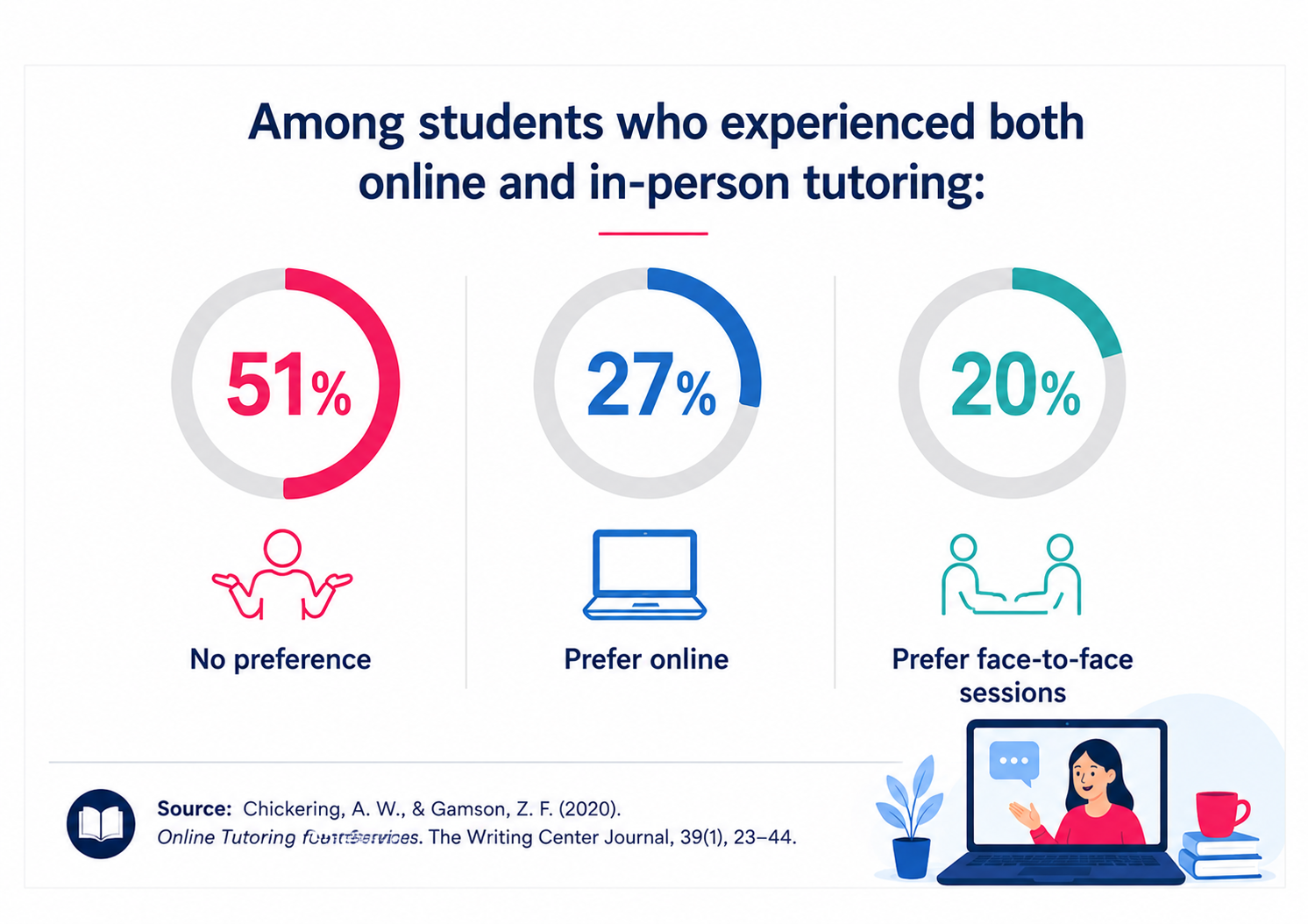
A 2020 study published in The Writing Center Journal explored students’ experiences with both online and face-to-face writing tutoring. Every participant in the study said they planned to return for another tutoring session, and an impressive 97% of them said they’d book another online session in the future.
Among the students who had experienced both online and in-person formats, just over half (51%) reported no preference. Meanwhile, more students preferred online tutoring (27%) than preferred face-to-face sessions (20%).
This goes to show that meaningful education depends on the quality of teaching, not on where or how that teaching takes place. However, this also doesn’t mean that the one format is universally better than the other. Each has its own strengths, so the right choice will ultimately depend on the student’s individual needs:
For tutors, in particular, online tutoring opens the door to business opportunities that just aren’t possible when working locally. In-person sessions are limited to students in one neighbourhood or city. With online sessions, however, you can build relationships with learners across the country, or even around the world.
Frequently asked questions
Does online tutoring work?
Yes. Many studies find that online tutoring can improve student learning when the lessons are well-designed and delivered by experienced teachers. The quality of the tutor and the consistency of lessons generally have the greatest impact on outcomes, not whether the tutoring happens online or in person.
Is online tutoring as effective as face-to-face?
It can be. Several studies have found that online tutoring produces learning outcomes and student satisfaction that are comparable to face-to-face tutoring. For many students, factors such as tutor quality, engagement, and regular practice play a much bigger role in success than the lesson format itself.
What subjects work best for online tutoring?
Almost any subject can be taught effectively online, including math, English, science, literacy, exam preparation, and creative subjects like writing. Modern virtual classrooms support live discussion, collaborative whiteboards, screen sharing, annotations, and shared documents, making it easy for tutors to adapt lessons to different subjects and learning styles.
Whether you’re an independent tutor or a growing tutoring organisation, Pencil Spaces gives you everything you need to deliver engaging online lessons. Try Pencil Spaces for free today, or book a free demo to see how our purpose-built virtual classroom can help you teach more students with confidence.