Customer story · Nonprofit literacy tutoring

How Augustine Literacy Project grew one-to-one reading tutoringand strengthened results

Augustine Literacy Project–Charlotte (ALP) runs its remote one-to-one reading tutoring on Pencil Spaces and is moving in-person tutoring onto the same delivery by 2027. Trained volunteers teach young readers in Title I elementary schools twice a week. In 2023–24, an independent UNC Charlotte evaluation found statistically significant reading gains.

A student in headphones builds words with letter tiles in a Pencil Spaces lesson on a school laptop, with her tutor on video
An ALP lesson on Pencil Spaces: letter tiles on the shared board, the tutor on video.
Organisation
Augustine Literacy Project–Charlotte
alpcharlotte.org ↗
Based in
Charlotte, North Carolina, since 2005
Serves
Kindergarten to second grade, in Title I schools in Charlotte-Mecklenburg Schools
Modèle
Volunteer tutors, one-to-one, two 45-minute lessons a week, free to families
On Pencil Spaces
Remote tutoring, since the 2023–24 school year

Results

More children, stronger reading.

Measured by an independent team at UNC Charlotte and by ALP’s own benchmarks.

46.1 points

First graders’ gain in at-or-above grade level on DIBELS in 2023–24, vs 23.7 for matched peers.

60 % et plus

More students served since 2021–22, by ALP’s benchmarks.

37%

Lower cost per child over the same period.

All of it delivered by volunteer tutors, in two 45-minute lessons a week.

Sources: Program Evaluation for Augustine Literacy Project–Charlotte, UNC Charlotte CEME, December 2025. Students served and cost per child are ALP organizational benchmarks reported in the evaluation.

The short version

One way to teach, every tutor, every lesson.

The challenge

Lessons depended on each tutor

Volunteers planned their own lessons and gathered their own materials. As ALP grew, keeping every lesson consistent got harder to see and to support.

What ALP built

Standardized Delivery

Scripted lessons, a shorter certification focused on teaching, a reflection after every lesson, DIBELS to track growth, and delivery and data capture through Pencil Spaces.

What happened

Stronger gains, more children

In 2023–24, ALP first and second graders made statistically significant gains over matched peers. Since 2021–22, ALP has served 60%+ more students at 37% lower cost per child.

The program

A tutor, a child and 45 minutes.

Since 2005, Augustine Literacy Project–Charlotte has trained volunteers to teach reading, writing and spelling one-to-one. Teachers in Charlotte-Mecklenburg Schools refer the young students who most need help with reading. An ALP tutor then works with each child for 45 minutes, twice a week, free to families.

Lessons follow the Orton-Gillingham approach: structured, cumulative and multisensory. Children hear a sound, say it, see it and build it, often with letter tiles. Over the years, ALP has helped more than 2,700 students from under-resourced communities reach reading proficiency.

When every tutor teaches it their own way

For most of its history, ALP trained volunteers in the breadth and depth of early literacy instruction. Each tutor then planned lessons and managed materials. In the first phase of the UNC Charlotte evaluation, which surveyed 135 tutors, one-to-one teaching came up as highly rewarding for tutors and children alike.

The same research found strain too. Some newer tutors wanted more training, and the program needed more monitoring and follow-up to keep lessons consistent.

To reach more children, ALP needed every tutor to teach the same strong lesson, and a way to see that it was happening.

What ALP built

Standardized Delivery: the lesson, the materials and the data in one place.

Beginning in spring 2023, ALP rebuilt how its tutoring is delivered. The two-year redesign came together in the 2023–24 school year. The evaluation says the changes “allowed tutors to focus more fully on the child and the power of relationship.”

  1. May 2023

    Scripted lessons

    ALP’s first scripted lessons run in a summer reading program.

  2. August 2023

    One curriculum

    The Standard Curriculum becomes the base of every new tutor training class.

  3. Aug–Oct 2023

    72 tutors retrained

    Existing tutors move from the older ALP curriculum to the scripted model.

  4. January 2024

    Espaces pour crayons

    Remote tutoring launches on Pencil Spaces, with scripted lessons, teaching and data capture in one place.

What changed for tutors

Tutors teach, they don’t plan

Scripted lessons keep instruction consistent from tutor to tutor. Volunteers no longer write lessons or manage materials.

Certified in three days

Tutor certification now centers on lesson delivery and error correction. It went from four days (24 hours) to three (18 hours).

A reflection after every lesson

For the first time, tutors fill in a reflection after each lesson, a steady feedback loop for coaching and improvement.

Growth measured on DIBELS

ALP adopted DIBELS, the assessment its partner schools already give, as its main measure of student growth.

ALP also started a Plan–Do–Check–Adjust cycle, using real-time data to refine lessons and support. With the new systems in place, many tutors chose to take on a second student.

Inside a lesson

The lesson is ready before they are.

Each tutor and child meet in their own Space. The scripted lesson lives there, so the 45 minutes go to reading, not setup.

Their own Space, lesson to lesson

Each tutor and child meet in the same Space every time, so boards and work are waiting where they left them.

Hands-on, on screen

Tutor and child move the same letter tiles and write on the same board, live, wherever each of them sits.

Child Mode for young readers

Students see five tools: draw, erase, move, undo and redo. Chat, boards and apps stay out of the way. Tutors keep every tool.

Lead and the waiting room

Tutors admit their student from the waiting room, then use Lead to bring the child to their view of the board.

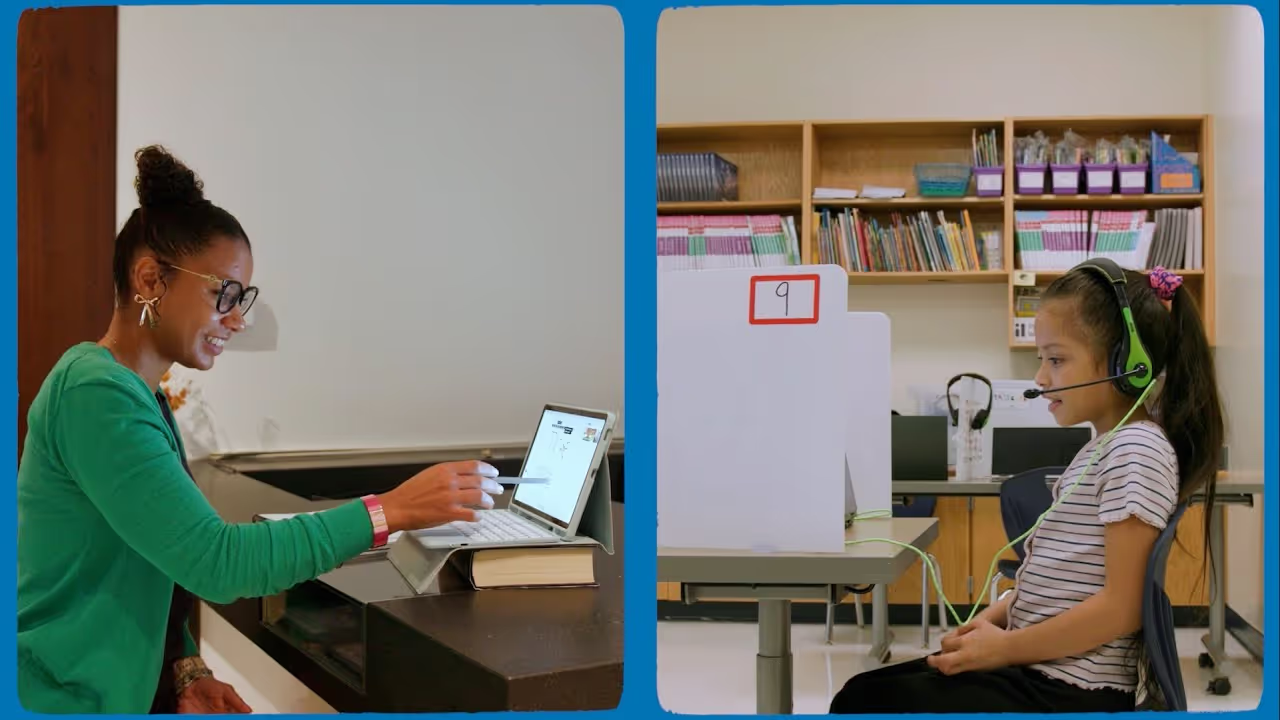
An ALP tutor teaches from her laptop while a student with a headset learns at a school desk

Watch: an ALP lesson on Pencil Spaces.

For ALP’s staff

Running a program, not just a lesson.

Twice-weekly lessons for hundreds of children only work if the logistics hold. For remote tutoring, ALP’s staff schedule, track and support every pair in Pencil Spaces too.

Recurring lessons

Staff set up each pair’s twice-weekly lessons as a recurring series, linked to the pair’s Space.

Attendance as it happens

Staff see who has joined, who is late and who is missing, updated during the lesson.

Reminder emails

Tutors get a reminder email before each lesson.

Decline alerts

When a tutor declines a lesson, ALP’s staff get an email, so no gap goes unnoticed.

The right people in the room

Tutors admit their student from a waiting room, so only the people meant to be there join.

A line to staff

Tutors can message ALP’s staff directly when something needs a hand.

Built together

Child Mode and reminder emails were built with ALP. ALP and the Pencil Spaces team meet every week to review what’s working and what comes next.

The independent evaluation

What UNC Charlotte found.

ALP commissioned the Center for Educational Measurement and Evaluation (CEME) at UNC Charlotte to evaluate its tutoring. The December 2025 report covers three school years, 2021–22 to 2023–24, in 19 Charlotte-Mecklenburg elementary schools.

Researchers compared ALP students with similar classmates who weren’t tutored, matched on starting reading scores, demographics, school and disability status. That design is called propensity score matching, and it was paired with a further adjustment for starting scores.

ALP reaches the children who need it most

ALP first and second graders started every year significantly behind their classmates on DIBELS. The model serves the students with the greatest literacy needs.

The strongest gains came in 2023–24

2023–24 was the first full year of ALP’s Standardized Delivery and the Pencil Spaces platform. That year, first graders’ gain in at-or-above grade level on DIBELS was 46.1 points vs 23.7 for matched peers.

First graders at or above grade level on DIBELS, 2023–24

Start of year to end of year, ALP students and matched peers

Start of yearEnd of year

Source: UNC Charlotte CEME, Table 8 and Figure 3. Percentages are first graders in the two DIBELS core-support bands (at or above grade level).

Gains were statistically significant in both grades that year. After adjusting for starting scores, ALP first graders scored an estimated 5.77 points higher than matched peers on the end-of-year DIBELS composite. Second graders scored an estimated 6.40 points higher (both p < .05). Estimates for the two earlier years, which had smaller samples, were not statistically significant.

The evaluators note that these results came from volunteer tutors meeting with students only twice a week for 45 minutes.

What the study does and doesn’t say

The evaluation doesn’t isolate any single component as the cause. It suggests that when Standardized Delivery and the Pencil Spaces platform worked together as one system, outcomes strengthened measurably. The design is quasi-experimental, not randomized, and uses one outcome measure, so the researchers call for further studies.

« Ces résultats n’auraient pas été possibles sans notre partenariat avec Pencil Spaces. La plateforme nous a permis de mettre en place une prestation standardisée à l’échelle de l’organisation, de renforcer la fidélité au programme et de mettre en place l’infrastructure nécessaire pour nous développer de manière responsable. À mesure que les résultats s’amélioraient, le coût par élève a diminué et le nombre d’élèves pris en charge a augmenté. »
SH
Steve HallExecutive Director, Augustine Literacy Project–Charlotte

What’s next

ALP is just getting started.

In-person lessons join in

ALP is moving all of its in-person tutoring onto the same standardized digital delivery, with the move scheduled to finish in 2027.

More children

ALP served more than 850 students in Charlotte-Mecklenburg Schools in 2025–26, and aims to reach 1,400 in 2026–27.

The next research

Next studies will ask whether gains last across years, compare in-person and online lessons in controlled designs, and test the model in more districts.

For other programs

Running a tutoring program? Five ideas from ALP’s model.

01Script the lesson, train the delivery

Volunteers do their best work when they teach a lesson rather than write one. Put training time into delivery and error correction.

02Keep materials where the lesson happens

When tiles, texts and activities already sit in the lesson’s Space, nobody starts the lesson hunting for them.

03Ask tutors to reflect after every lesson

A reflection each time gives staff a steady signal on quality, and tutors a reason to pause and notice.

04Measure with the assessment schools already use

ALP’s switch to DIBELS let it compare its students with their own classmates.

05Invite an independent evaluation

Matched comparisons from a university team give schools, districts and funders evidence they can check.

Questions

About ALP and Pencil Spaces.

What is the Augustine Literacy Project?

Since 2005, Augustine Literacy Project–Charlotte (ALP) has given young students in Title I schools in Charlotte-Mecklenburg Schools free one-to-one reading tutoring. Trained volunteer tutors teach lessons based on the Orton-Gillingham approach, 45 minutes twice a week, to the children their teachers refer.

Who are ALP’s tutors?

ALP’s tutors are trained community volunteers. ALP certifies them in a three-day, 18-hour course focused on lesson delivery and error correction. Scripted lessons mean they don’t have to plan lessons or gather materials. A reflection after every lesson keeps ALP’s staff close to how each tutor is doing.

How does the Augustine Literacy Project use Pencil Spaces?

ALP delivers its remote tutoring on Pencil Spaces, and is moving its in-person tutoring onto the same delivery by 2027. Each tutor and child meet in their own Space and work on the same board, with letter tiles, writing and video. The student sees the simpler Child Mode toolbar. ALP’s staff schedule recurring lessons, follow attendance and get an email when a tutor declines a lesson.

What did the UNC Charlotte evaluation of ALP find?

In an independent UNC Charlotte evaluation (December 2025), first graders’ gain in at-or-above grade level on DIBELS was 46.1 points vs 23.7 for matched peers in 2023–24. That was the first full year of ALP’s Standardized Delivery and the Pencil Spaces platform. ALP first and second graders both made statistically significant gains over matched peers that year.

Did Pencil Spaces cause the reading gains?

The evaluation doesn’t isolate any single component as the cause. The strongest effects coincided with scripted lessons, enhanced training, structured monitoring and delivery and data capture through Pencil Spaces, working together. It suggests that when Standardized Delivery and the Pencil Spaces platform operated as one system, outcomes strengthened measurably. ALP’s volunteer tutors do the teaching.

Can other tutoring programs run a model like ALP’s on Pencil Spaces?

Yes. Pencil Spaces runs one-to-one and small-group tutoring for nonprofits, schools and districts, in school or online, on Chromebooks, tablets and laptops with nothing to install. Students can sign in with Clever, ClassLink or Google. Get a demo and we’ll walk through lessons, scheduling and reporting for your program.

Run high-impact tutoring

Let’s look at your program.

See how your tutors, lessons and schedules would run on Pencil Spaces, in school or online.

Gratuit pendant 2 semaines avec n'importe quelle formule payante. Aucune carte bancaire requise.

More customer stories