


.png)
Key takeaways:
- One of the core components of online math tutoring is a shared digital whiteboard where the tutor and student write, draw, and solve problems together.
- Step-by-step visibility matters more for mathematics than most subjects, as students need to see each stage of a solution, not just the final answer.
- Common tools include color-coding to separate steps, graphing for visualizing functions, and a formula or equation editor for clean mathematical notation.
- Tutors often use the “show your work” approach in reverse: they watch how a student attempts a problem live to reveal exactly where their understanding breaks down.
- Effective online math tutoring combines live video for explanation and rapport with a persistent, infinite whiteboard for the actual math work.
Online math tutors teach by working through problems live with students in a virtual classroom, using both video and audio for real-time discussion. While discussing the problem together, the tutor and student can simultaneously write out equations, graphs, and diagrams on a shared digital whiteboard in the same way they would on a physical whiteboard.
Since math relies very heavily on visual representation, most of the actual teaching in an online math class occurs through writing and drawing, rather than just talking. For instance, the tutor will solve an equation step-by-step on screen, while explaining their reasoning aloud. While mathematics depends heavily on visual problem-solving, subjects like literacy use many of the same virtual classroom tools in different ways.
What does a typical online math tutoring session look like?
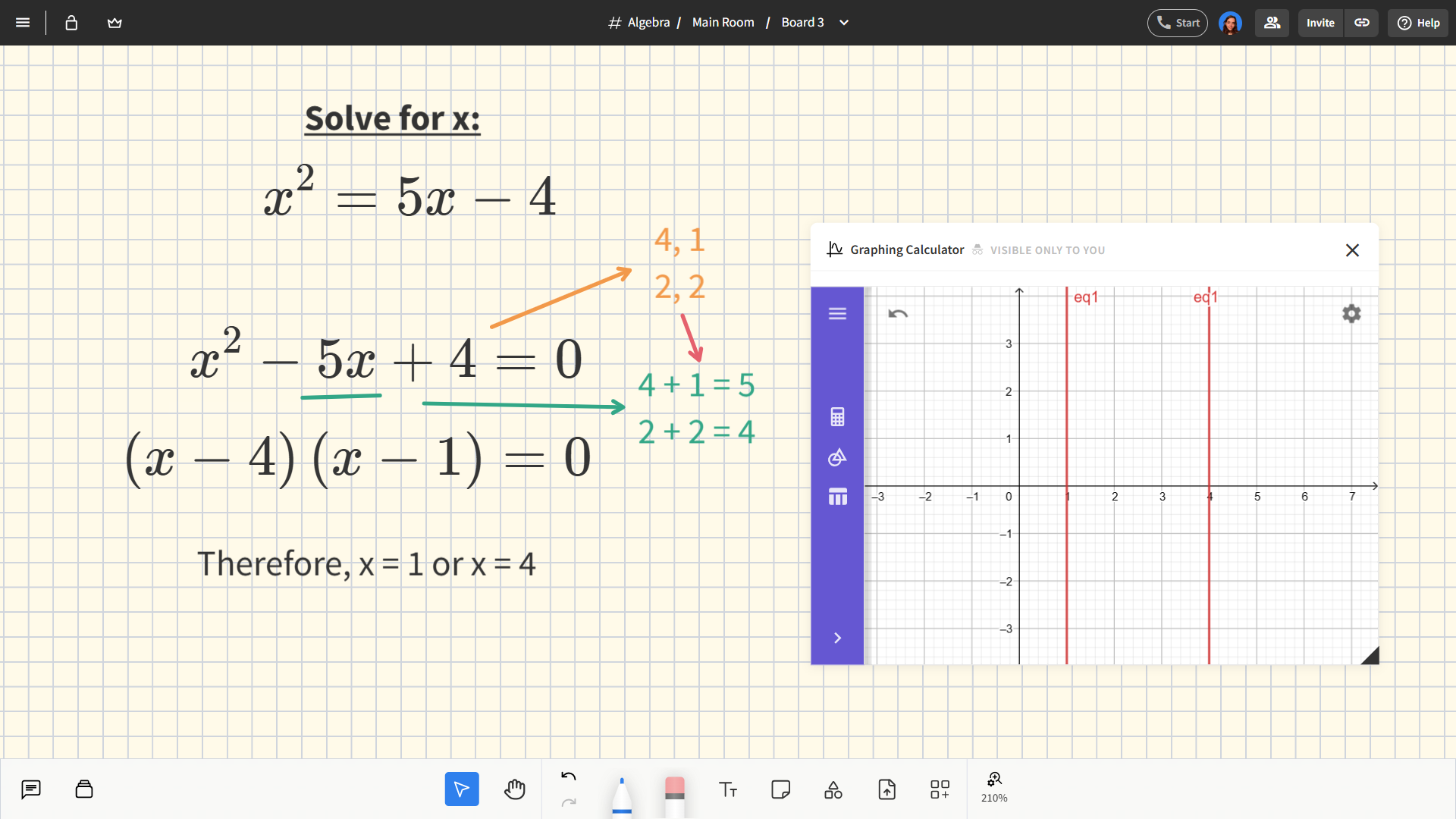
A session usually starts with the tutor and student joining a video call, then moving most of the actual work onto a shared whiteboard. Instead of simply lecturing while the student listens, effective online math tutoring is often interactive: the student attempts to solve a problem (or part of one) on the board while the tutor watches.
The best online mathematics tutors will also use virtual whiteboards to support collaborative problem-solving during their lessons. For instance, they may use their infinite whiteboard to solve equations together, label geometric figures, and work through proofs.
Research supports this collaborative approach. A 2020 study published in PRIMUS found that students learned mathematics more effectively when online lessons encouraged students to interact and participate within the class, rather than just passively observe.
Platforms built specifically for online math tutoring make this kind of interaction much easier. For example, Pencil Spaces’ virtual classroom for math tutoring combines a collaborative infinite whiteboard with a built-in online equation editor, support for LaTeX and freehand mathematical notation, integrated graphing tools like Desmos, and live annotation.
Instead of switching between multiple apps, tutors can explain concepts, graph functions, write equations, and collaborate with students from a single virtual classroom.
Why is the whiteboard more important than the video call for math?
Unlike discussion-based subjects, mathematics depends heavily on students being able to visualize concepts. Equations need to be rearranged one line at a time, graphs need to be sketched, geometric figures need to be labeled, and diagrams need to evolve as new information is introduced. A video conversation alone cannot provide the visual workspace that mathematical thinking requires.
Students also need room to experiment, as solving a math problem is not always a linear process. Learners often benefit from having space to write rough calculations, test different approaches, cross out their mistakes, and draw supporting diagrams before arriving at their final answer. A shared digital whiteboard gives them the freedom to work through this process naturally, just as they would with pen and paper.
Step-by-step problem-solving is just as important. Seeing every stage of a solution helps students understand why each step happens, instead of simply memorizing the final answer. For this reason, the best platforms, including Pencil Spaces, place an infinite whiteboard for math teaching at the center of the learning experience.
What specific techniques do online math tutors use?
Color-coding steps
It’s helpful for a tutor to assign different colors to different stages of a problem. They might, for example, isolate a variable in one color and simplify the equation in another to make each transformation visually distinct.
Working problems live, not pre-recorded
Watching a student attempt a problem live, rather than reviewing their answers afterward, allows a tutor to see exactly where reasoning goes wrong. This way, they can see whether it’s a sign error, a misapplied formula, or a conceptual misunderstanding.
Graphing alongside algebra
Visualizing equations with graphing tools is particularly helpful when a student struggles to grasp certain concepts. This is especially true for functions, transformations, or anything spatial.
Using a proper formula editor
Typing math by hand with a standard keyboard is clumsy and tedious. Online math tutors will frequently use dedicated equation editors, LaTeX support for more complex notation, or handwriting recognition that converts written equations into clean typed math.
Annotating existing materials
Many tutors will upload worksheets, textbook pages, or past tests directly onto the whiteboard and annotate over it. This allows them to work through the student’s actual coursework as opposed to generic practice problems.
What tools do online math tutors need?

At the very least, an effective online math tutoring setup should include a collaborative whiteboard, video and audio for live discussion, and some means for writing mathematical notation cleanly, instead of having to type it out character by character.
On top of that baseline, tutors may also add a graphing tool for visualizing functions, the ability to upload and annotate existing documents like worksheets or past assignments, and a way to record sessions so students can review the explanation again later.
This is why many tutors prefer an all-in-one virtual classroom built specifically for mathematics. Pencil Spaces combines live video, an infinite collaborative whiteboard, a built-in equation editor, LaTeX support, Desmos graphing, document annotation, breakout rooms, session recordings, and persistent lesson boards in a single browser-based platform.
How is online math tutoring different from in-person tutoring?
The core teaching method doesn’t change much between in-person and online math tutoring. Working through problems step by step, visually, with the ability to discuss the problem together, is effective regardless of whether it happens at a kitchen table or over video.
The only things that change between in-person and online math tutoring are the medium:
- A digital whiteboard replaces a notebook or a physical whiteboard
- Video and audio replace being in the same room
- Tools like color-coding, graphing, and equation editors do digitally what a tutor would otherwise do with markers and a calculator
A good online mathematics tutor should be able to replicate every part of the visual, collaborative feel of in-person math instruction.
Importantly, research suggests that online mathematics tutoring can be just as effective as in-person instruction when students remain engaged and supported throughout the learning process. A 2023 study published in the International Journal of Research in Undergraduate Mathematics Education found that students’ confidence in their mathematical abilities predicts success in both in-person and online tutorials.
This reinforces the importance of tutors going above and beyond simply sharing their screen to host an effective online math class. The best lessons make it easy for students to work through problems themselves, ask questions, receive immediate feedback, and collaborate with their tutor on a shared whiteboard because these features are essential for learners to stay engaged and confident during their session.
Pencil Spaces gives math tutors a persistent, infinite whiteboard with a built-in formula editor (keyboard, LaTeX, or handwriting-to-math conversion), all in the same tab as video calling. Try Pencil Spaces for free or get a demo.